Copernicus
Physics Olympiad
The Copernicus Physics Olympiad is an international academic competition that encourages students to explore the fundamental principles of physics and develop a deeper understanding of the physical world.
The Olympiad challenges students with thought-provoking questions that strengthen critical thinking, analytical reasoning, and problem-solving skills, while providing an opportunity to test their physics knowledge on an international platform.
It also inspires students to pursue future studies and careers in physics, engineering, technology, and other STEM fields.
Physics Olympiad
Rules And Regulations
Please ensure you carefully follow all exam rules and regulations:
- The Copernicus Physics Olympiad is an international competition open to students from Grades 7 to 12.
- The Olympiad consists of two rounds: the Preliminary Round and the Global Round.
- Students may register online via the website or get registered through their schools.
- All registered participants will take an online qualifying exam for the Preliminary Round.
-
The examination process is divided into two rounds.
1. Preliminary Round.
2. Global Round.
How to Qualify?
Copernicus Physics Olympiad
Here are some guidelines to follow for qualifying in Physics Olympiad,
1.
The exam includes a total of 20-25 questions: 15 multiple-choice questions and 5 open- ended questions designed to assess deeper understanding and critical thinking.
2.
The duration of this paper is 60 minutes.
3.
Students must take the exam based on their respective grade category:
✔ Category 1 – Grades 7 & 8
✔ Category 2 – Grades 9 & 10
✔ Category 3 – Grades 11 & 12
4.
Students who score at least 60% in the Preliminary Round are eligible to participate in the Global Round.
5.
Global Round qualifiers must complete a separate registration on the official website.
6.
The date and venue of the Global Round will be announced after the Preliminary Round results are announced.
7.
The Global Round exam features 20 questions: 15 multiple-choice questions and 5 open- ended questions covering Physics, with subcategories similar to those in the Preliminary Round.
Physics Olympiad
Awards
Below are the Award details for both the Preliminary and Global Rounds of the Physics Olympiad.
Preliminary
Round:
- All Preliminary Round participants, regardless of score, will receive a Certificate of Participation.
- Students who qualify for the Global Round will receive a Certificate of Achievement and a medal (gold, silver, or bronze) based on their Preliminary Round performance.
- In the Preliminary Round, medals will be awarded based on the following percentages:
Top 91% – 100% will get Gold Award
Next 80% – 90% will get Silver Award
Next 65% – 79% will get Bronze Award
Next 40% – 64% will get Honorable Mention Award
- The absolute winner (youngest top scorer) of each category will receive free participation in the Global Round.
Global
Round
- All Global Round participants, regardless of score, will receive a Certificate of Participation.
- In the Global Round, medals will be awarded based on the following percentages:
Top 91% – 100% will get Gold Award
Next 80% – 90% will get Silver Award
Next 65% – 79% will get Bronze Award
Next 40% – 64% will get Honorable Mention Award
Category (1-3)
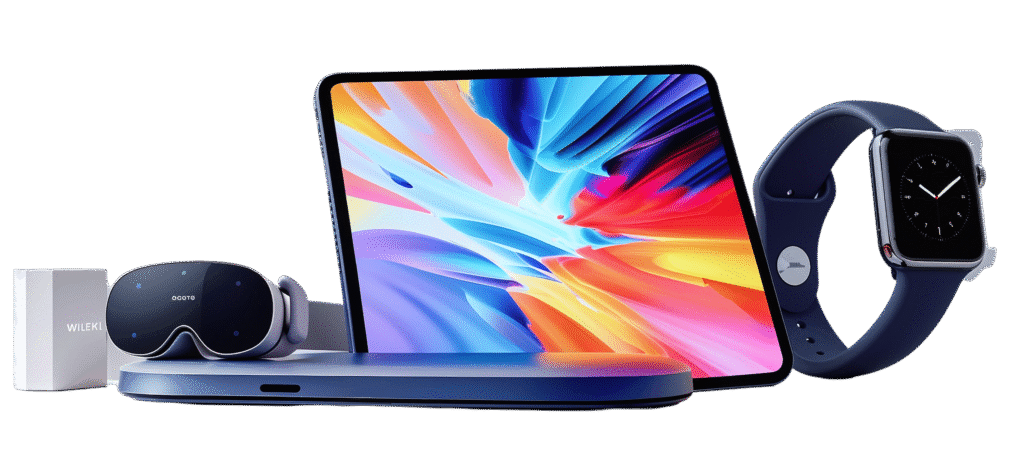
1st place – iPad / MacBook
2nd place – Oculus Quest 2
3rd place – Apple Watch SE
Syllabus
Physics Olympiad
Category 1 (Grades 7 & 8)
Physics
• Newton’s laws of motions
• Types of forces
• Speed, velocity, and acceleration
• Simple machines
• Forms of energy
• Energy transformation
• Conservation of energy
• Properties of sound waves
• Sound dispersion and the Doppler effect
• Properties of light
• Behavior of light
• Lenses and their application
• Electromagnetic spectrum
• Electric circuits and components
• Heat transfer
• Properties of fluids
• Fluids dynamics
• Buoyancy and Archimedes principle
Category 2 (Grades 9 & 10)
Physics
- Kinematics (motion in one and two dimensions)
- Circular motion and gravitation
- Work, power, and energy
- Temperature, heat, and thermal expansion
- Laws of thermodynamics
- Conduction, convection, and radiation
- Electric circuit and Ohm’s law
- Electric potential, voltage, and current
- Wave properties
- Sound waves, their characteristics, and behavior
- The Doppler effect and wave interference
- Electric charges and fields
- Coulomb’s law and electric potential energy.
- Electric flux and Gauss’s law
- The photoelectric effect and wave-particle duality.
- Nuclear physics (atomic structure, radioactivity)
- The behavior of gases and gas laws (Boyle’s law, Charles’s law, etc.).
- Ideal gas law and kinetic molecular theory
Category 3 (Grades 11 & 12)
- Conservation laws (momentum, angular momentum)
- Impulse and collisions
- Rotational motion and torque
- Gravitation beyond basic concepts
- Kinetic theory of gases
- Thermodynamic processes (isothermal, adiabatic, etc.)
- Entropy and the second law of thermodynamics
- Electromagnetic induction
- Faraday’s law of electromagnetic induction.
- Lenz’s law
- Alternating current (AC) circuits
- Interference and diffraction of light
- Polarization of light
- Modern optics, including wave-particle duality.
- Quantum mechanics in the context of light and photons
- Special theory of relativity.
- Quantum mechanics, wave functions, and probability.
- Atomic and molecular physics.
- Nuclear physics and particle physics
FAQs
Helping You Understand International Contests Center (ICC) Better.
follow the link to get the preparatory Material,
https://icccenter.com/
More than 5 students will appear paper base and less than 5 students will appear online.
For Natural Science/ Maths: Grade (02 to 12 & O/A Level)
For Physics & Astronomy: Grade (08 to 12 & O/A Level)
For English: Grade 1 - 10
Last date of submit the registration form for Natural Science and Physics Atronomy is 28 August 2025.
For a private participant, you need to have the following requirements for the Olympiad:
1) Strong & Stable Internet
2) Individual Laptop/ Mobile/ Tablet
3) Camera and Mic should be working
Please send all your questions and comments to info@icccenter.com or call directly to ICC Support Team +92423-6662377, +92-423-6612109, +92-300-5866609, +92-300-4266810 . Your queries will be addressed straight away.